 Skip to main content
- Home
- About
-
Grow mediaCoco peat blocks Bulk loose coir pith Coco husk chipsGrow bagsCoir grow bags Open-top grow bagsPropagationSeed starter pellets Propagation cubes Coir fibre bales View all products →
-
By cropCannabis Tomatoes StrawberriesBy applicationGreenhouse Horse bedding Mushroom substrate All solutions →

Open Top Coco Coir Bags: Which Gallon Size Do You Need?
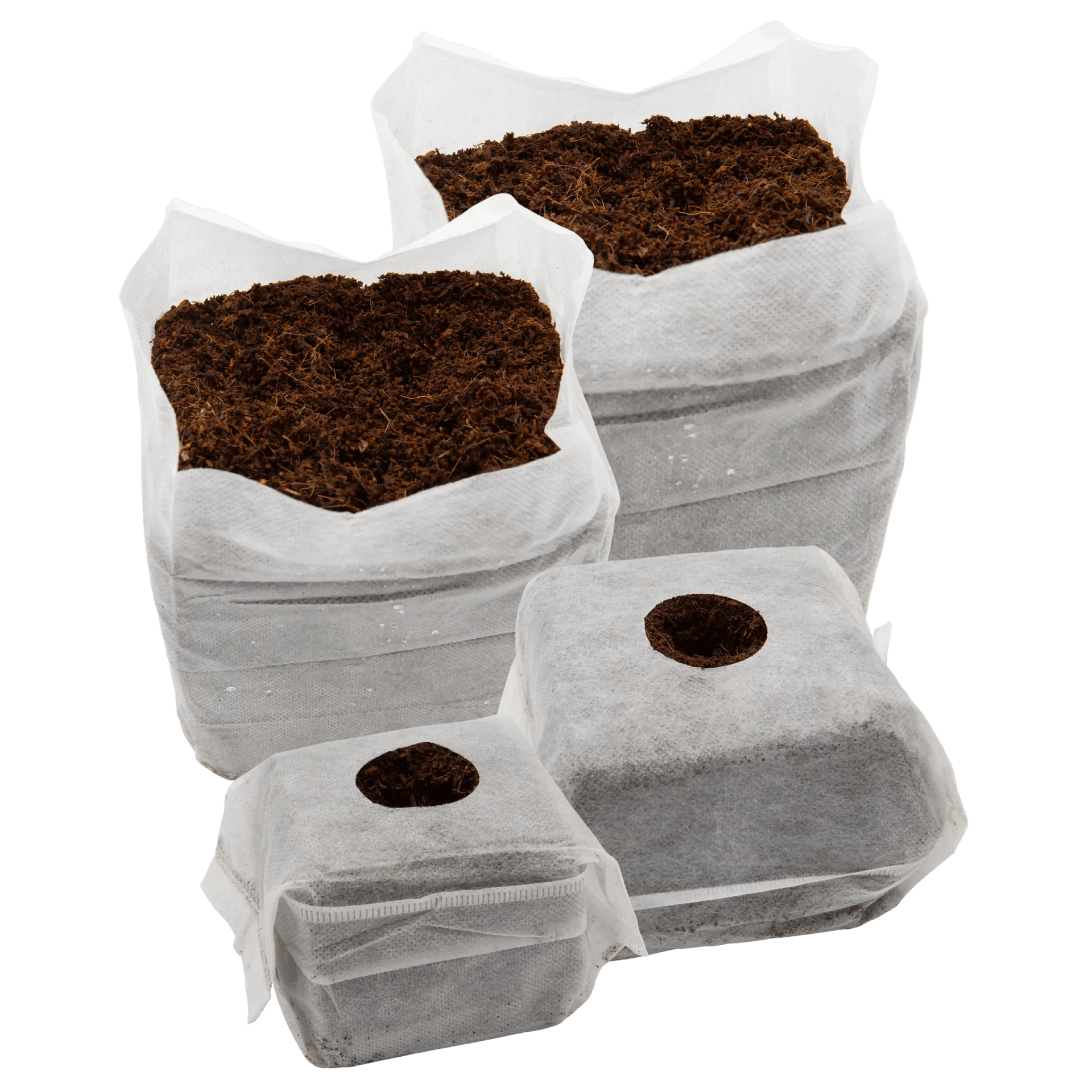
Open-top coco coir bags are the standard substrate format for tabletop and container production — strawberries, blueberries, ornamentals, and smaller fruiting crops. But growers often default to whatever size their last supplier stocked, without checking whether it actually matches their crop's root system or spacing plan.
This guide compares 1, 1.5 and 2 gallon labels for open-top coco coir bags. Confirm actual hydrated dimensions and usable volume before selecting a format.
Sizing Breakdown: 1, 1.5 & 2 Gallon
The smallest nominal size in this comparison. Assess the hydrated footprint, usable fill and crop duration before choosing it for a tighter spacing plan. A smaller label does not by itself establish suitability for a particular crop.
The middle nominal size is an option to compare, not an automatic safe default. Confirm actual dimensions, usable volume and quoted cost against the other candidates before deciding.
The largest nominal size in this comparison. Check whether its hydrated footprint fits your bench or gutter and whether the added volume is justified. It does not guarantee better yields or suitability for multiple seasons.
If the required size is uncertain, confirm dimensions and usable volume with the supplier and agree a representative trial with your growing team before ordering at scale.
Head-to-Head Comparison
| Size | Volume | What to Verify | Assessment Focus |
|---|---|---|---|
| 1 Gallon | ~3.8 L | Footprint and usable fill | Tighter spacing plans |
| 1.5 Gallon | ~5.7 L | Dimensions and usable fill | Intermediate volume requirement |
| 2 Gallon | ~7.6 L | Footprint and handling fit | Larger volume requirement |

Quick Decision Guide
- High-density tabletop system → check footprint and spacing
- Uncertain strawberry sizing → confirm requirements before selecting
- Perennial or multi-season plans → assess crop duration and substrate condition
- Small ornamentals → check crop and container requirements
- Larger ornamentals → verify usable volume and physical fit
- Plant count per bench/gutter → measure the full layout
- Plant health and yield → do not infer results from size alone
Why Bag Size Affects More Than Root Space
Irrigation frequency. Bag volume alone does not determine a watering schedule. Review the irrigation requirements alongside the crop, substrate, environment and container geometry before changing formats.
Cost per plant vs. cost per bench. Compare actual quotations, freight, plant count, handling and intended crop duration. Neither a lower unit price nor a larger bag guarantees lower operating costs.
Bench/gutter spacing compatibility. Bag footprint needs to match your existing bench or gutter system — check the physical width of your setup before assuming a size upgrade is a straightforward swap.
What to Confirm Before Ordering
Assess substrate quality and bag dimensions together; neither replaces the other:
- Processing status — confirm washing, buffering and preparation instructions for the exact product
- EC and pH lab data — request the agreed specification, test method and relevant batch documentation rather than assuming one numerical range applies to every product and crop
- Consistent fill density — bags that are inconsistently packed create uneven water distribution across a bench, even at the same nominal gallon size
Note: Approve physical fit and substrate quality together. Document trial findings before scaling instead of treating either size or buffering as a performance guarantee.
Sourcing Across Canada, USA & Mexico
For Canada, USA or Mexico enquiries, confirm the ordered size, availability, stock location and delivery requirements in writing. Agree dispatch and transit estimates before committing to a planting date. Plan storage for unused grow bags before delivery.
Choose the Size That Fits Your Verified Requirements
There is no universal winning size. Compare actual hydrated dimensions, usable volume, substrate specification and delivered cost, then have your growing team evaluate suitability for the crop and system. Confirm the blend and processing for each ordered format rather than assuming identical material in every size.
Ready to Order Open Top Bags?
Request a quotation for your required size, quantity and destination. Availability, specifications and delivery timing are confirmed per order.