
- Home
- About
-
Grow mediaCoco peat blocks Bulk loose coir pith Coco husk chipsGrow bagsCoir grow bags Open-top grow bagsPropagationSeed starter pellets Propagation cubes Coir fibre bales View all products →
-
By cropCannabis Tomatoes StrawberriesBy applicationGreenhouse Horse bedding Mushroom substrate All solutions →
Wholesale Coco Coir Grow Bags, 9–38.5L
Coco coir grow bags, 9L–38.5L standard or built to spec.
Manufactured at our own Tamil Nadu facility — triple-washed, calcium-buffered, pre-filled, and ready to plant. Ships directly from our Cambridge, Ontario warehouse across Canada, the USA, and Mexico. No brokers, no aged stock, no waiting.
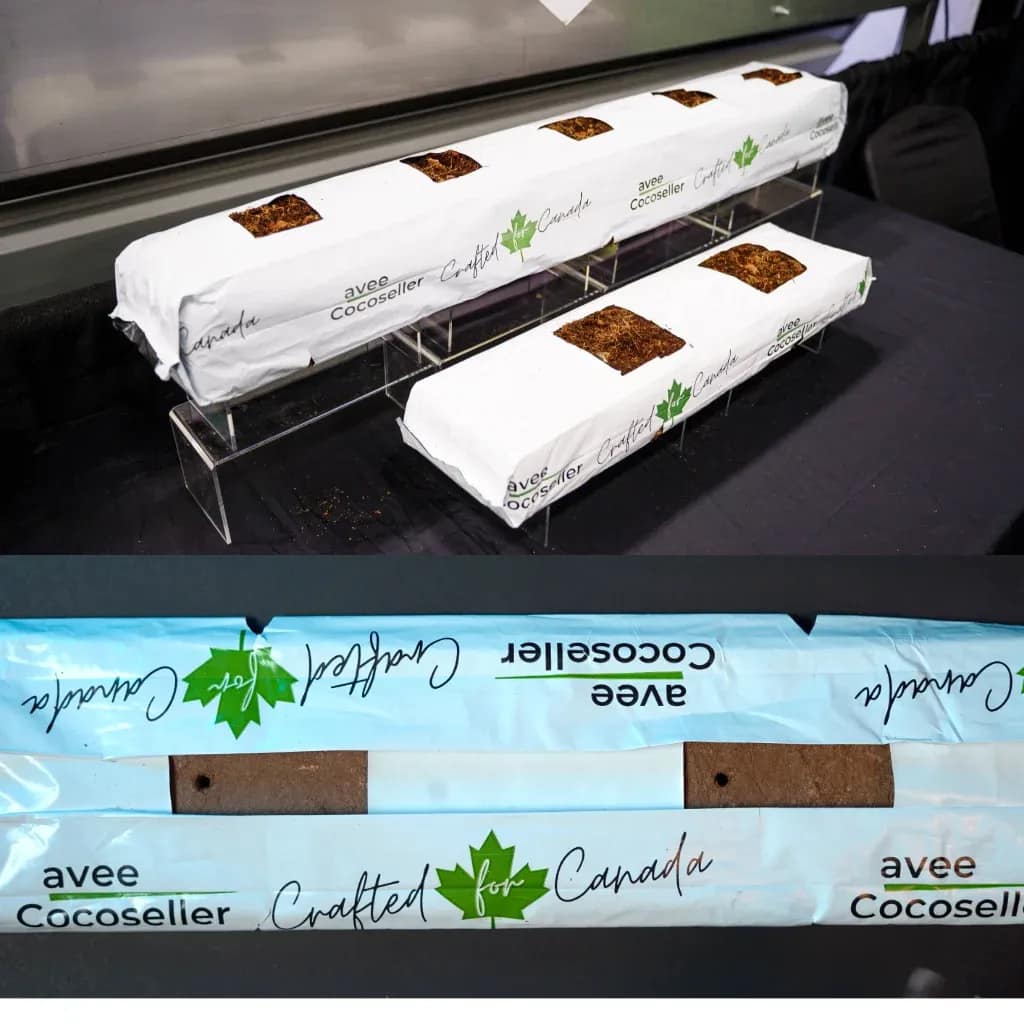
Tap any thumbnail to switch the main image.
Engineered for cannabis, tomato & commercial greenhouse production.
Pre-filled, pre-buffered, and sized to match your operation — not the other way around.
Target below 0.5 mS/cm; confirm the ordered batch
Every bag is triple-washed and calcium-buffered at source, then lab-tested before shipping. Review the applicable batch documentation for the ordered product — critical for cannabis LPs and commercial greenhouse nutrient programs.
Ready to plant, no extra soak
Each bag is pre-buffered with calcium nitrate before filling, displacing sodium from cation exchange sites. Your plants get a clean, stable substrate from the first irrigation.
9L to 38.5L — any crop, any format
Small bags suit herbs and propagation; medium bags suit tomato and cucumber rows; large-format bags are built for cannabis and high-density greenhouse crops. Custom dimensions are available for any row spacing.
Factory price, no middlemen
We own the production facility in Tamil Nadu. You pay factory price plus freight — not factory price plus three layers of distributor margin. The saving on pallet volumes is significant.
Coco Coir Grow Bags — Full Specs
| Material | 100% natural coconut husk — coir pith & chip blend |
| Bag Type | UV-stabilized polyethylene, pre-filled |
| EC | <0.5 mS/cm — triple-washed |
| pH Range | 5.5–6.5 |
| Moisture Content | <20% (factory-dried) — standard for pre-filled, non-compressed formats |
| Air-Filled Porosity | 28–33% |
| Water Retention | Holds 7–8× its weight |
| Chip Size | Fine 2–4mm / Medium 6–9mm / Coarse 12–18mm |
| Buffering | Calcium nitrate pre-buffered |
| Pathogens | Heat-treated — pathogen testing and Certificate of Analysis availability must be confirmed for the ordered batch |
| UV Stabilization | Yes — outdoor & greenhouse grade |
| Shelf Life (dry) | Up to 2 years in dry ventilated storage |
| Origin | Manufactured in Tamil Nadu, India |
| Warehouse | Cambridge, Ontario, Canada |
| Mexico Shipping | Lanes expanding — contact us to confirm |
Find Your Grow Bag Size
| Tier | Dimensions | Volume | Best For |
|---|---|---|---|
| Small | 50×15×12 cm | 9L | Herbs, propagation |
| Small | 60×15×12 cm | 11L | Herbs, strawberries |
| Small | 65×15×12 cm | 12L | Peppers, herbs |
| Small | 65×18×12 cm | 14L | Peppers, small crops |
| Medium | 80×20×12 cm | 19L | Tomato, cucumber |
| Medium | 90×18×12 cm | 19.5L | Tomato rows |
| Medium | 100×15×12 cm | 18L | Cucumber, pepper |
| Medium | 100×18×12 cm | 22L | Commercial tomato |
| Medium | 120×20×10 cm | 24L | Long-row greenhouse |
| Large | 100×18×15 cm | 27L | Cannabis, tomato |
| Large | 80×22×20 cm | 35L | Cannabis, large crops |
| Large | 80×24×20 cm | 38.5L | High-density cannabis |
Ready to plant in 5 simple steps
Our coco coir grow bags arrive pre-filled and compressed. Hydration takes about 20–30 minutes depending on bag size.
Position the bag
Place the grow bag in your greenhouse row or growing area, flat and level for even water distribution.
Cut drain slits
Cut 2–4 drainage slits along the bottom, about 1–2cm long, to prevent waterlogging through the season.
Hydrate fully
Add 13–25 litres of water evenly over the surface depending on bag size, then allow 20–30 minutes for full absorption.
Cut planting holes
Cut circular or square planting holes on top — standard spacing is 2 plants per medium bag, 1–2 per large bag for cannabis.
Plant & feed
Insert transplants or rockwool cubes, begin your nutrient feed at target EC, and check runoff EC and pH after first irrigation.
Avee grow bags vs. other coco coir grow bags
Based on publicly available competitor information. Last updated March 2026.
| Feature | Avee Cocoseller | Vancouver Coir / Resellers | IncrediGrow / GrowPharm | US Suppliers |
|---|---|---|---|---|
| EC Target & Documentation | ✓ <0.5 mS/cm — lab doc | Stated, no lab docs | Stated, no lab docs | Listed, varies by batch |
| Manufacturer-Direct | ✓ Own Tamil Nadu factory | ✗ Reseller / importer | ✗ Distributed brand | ✗ Broker / reseller |
| Custom Sizes | ✓ Full range + custom | Limited options | Limited options | ✗ Fixed sizes only |
| Calcium Pre-Buffered | ✓ Ca(NO₃)₂ treated | ✗ Washed only | Some products | Some products |
| Ontario-Stocked | ✓ Cambridge, ON warehouse | BC only | BC / ON — limited | ✗ USA only |
| Lab Docs Per Batch | ✓ Available on request | ✗ Not offered | ✗ Not offered | Some offer OMRI cert |
| UV-Stabilized Bag | ✓ Standard on all bags | Varies by product | Varies by product | ✓ Standard |
| Ships to USA & Mexico | ✓ USA now, Mexico expanding | ✗ Canada only | ✗ Canada only | ✓ US domestic |
Who uses Avee coco coir grow bags
Licensed producers
27L–38.5L bags are sized for high-density cannabis canopy, pre-buffered and consistent in EC batch to batch, with documentation that licensed producers can assess within their own quality system.
Commercial tomato
100–120cm medium bags suit high-wire tomato production, offering optimal drainage and water retention for continuous fertigation in commercial greenhouses.
Cucumber & pepper
Medium format 80–100cm bags provide excellent drainage and root aeration, with custom row spacing available for any greenhouse layout.
Strawberry & soft fruit
Small format 50–65cm bags are designed for elevated strawberry production. The fine coir blend retains moisture between irrigations, critical for berry quality.
Commercial greenhouse
Full pallet supply from Ontario means no import delays, with custom sizes for any row width and consistent product season over season.
Hydroponics & NFT
Low EC and calcium-buffered substrate is ready for high-frequency fertigation, compatible with all major hydroponic nutrient programs.
Coco coir grow bags — questions answered
The most common questions from Canadian, US, and Mexican growers. Don't see yours? Ask us directly.
Do I need to add Cal-Mag before planting into your grow bags? +
What size grow bag is best for cannabis? +
What size is best for commercial tomato production? +
Can I get custom drainage holes or planting holes pre-cut? +
What is the EC of your grow bags out of the bag? +
Do you ship grow bags to the USA and Mexico? +
Buy coco coir grow bags in Canada — factory-direct from Avee Cocoseller
Avee Cocoseller's coco coir grow bags are Canada's best-value factory-direct substrate for commercial greenhouse and hydroponic production. We manufacture at our own facility in Tamil Nadu, India and ship directly to growers from our Cambridge, Ontario warehouse, with Mexico distribution expanding. Every bag is triple-washed, calcium-buffered, pre-filled, and lab-tested before it leaves our facility.
Why coco coir grow bags outperform rockwool and peat
Rockwool is increasingly restricted in European markets and faces growing disposal scrutiny in Canada. Coco coir grow bags, by contrast, are the coir substrate can support responsible end-of-life programs where local rules and crop-health controls allow; plastic sleeves must be handled separately, matching rockwool's water retention and aeration while offering superior sustainability credentials — important for LP compliance and retail certifications. For more on sustainable growing media, see our guide to buffered vs. unbuffered coco coir.
Custom sizes for any row spacing
Canadian and US greenhouse operations use a wide range of row spacings depending on crop type and structure. Our standard range covers 9L to 38.5L, and we manufacture custom sizes for any row width, plant spacing, or drainage configuration, subject to custom-production minimums confirmed in the quote.
Coco coir grow bags for cannabis, tomato & greenhouse crops — Canada, USA & Mexico
Our pre-filled coco peat grow bags are the preferred substrate for high-value greenhouse crops across Canada and the USA. Cannabis licensed producers choose our bags for consistent EC, documentation support, and large-format sizing. Commercial tomato and cucumber operations choose us for pallet-volume supply, custom row lengths, and Ontario warehouse proximity.
Serving growers across North America
We ship from Cambridge, Ontario to all ten Canadian provinces and all 50 US states, with Mexico shipping lanes expanding as we build out cross-border freight. Our fastest lanes serve Ontario's Leamington greenhouse corridor, the Niagara Region, and the Greater Toronto Area, reaching further into BC's Fraser Valley, Alberta's indoor farms, and Quebec's commercial operations. Contact us for freight rates and current Mexico availability.
Wholesale & distributor supply
We supply grow media distributors, hydroponic retailers, licensed cannabis producers, and commercial greenhouse operators across Canada and the USA, with Mexico distribution underway. Pallet pricing, container pricing, private-label packaging, and custom blend specifications are all available. Request a wholesale quote.
Ready to order coco coir grow bags?
Custom sizes, pallet loads, and container orders — shipped to Canada and the USA from our Ontario warehouse, with Mexico lanes expanding. Request a commercial quote.
Confirm the commercial specification before ordering
Published dimensions, expansion, EC, pH, pallet quantities and packaging are product targets or typical configurations. Confirm the selected grade, current inventory, minimum order, pallet configuration, applicable batch documentation, destination access and freight terms in your quotation before committing a crop schedule.