 Skip to main content
- Home
- About
-
Grow mediaCoco peat blocks Bulk loose coir pith Coco husk chipsGrow bagsCoir grow bags Open-top grow bagsPropagationSeed starter pellets Propagation cubes Coir fibre bales View all products →
-
By cropCannabis Tomatoes StrawberriesBy applicationGreenhouse Horse bedding Mushroom substrate All solutions →
Coco Coir for Controlled-Environment Growers in Grande Prairie, Alberta
Grande Prairie’s economic development strategy names greenhouse and vertical agriculture as a priority investment sector, and Northwestern Polytechnic’s smart-agriculture research program is testing controlled-environment methods in the same region where growers will eventually run them at commercial scale. Moving a project from pilot module or research plot to a working greenhouse or hydroponic unit means locking down one variable that production plans too often leave until late: root-zone media. A-Vee supplies compressed coco coir blocks and grow bags with documented EC and pH ranges, sized for greenhouse bench systems, container culture, and modular hydroponic units — with freight quoted against your Grande Prairie postal code rather than assumed.
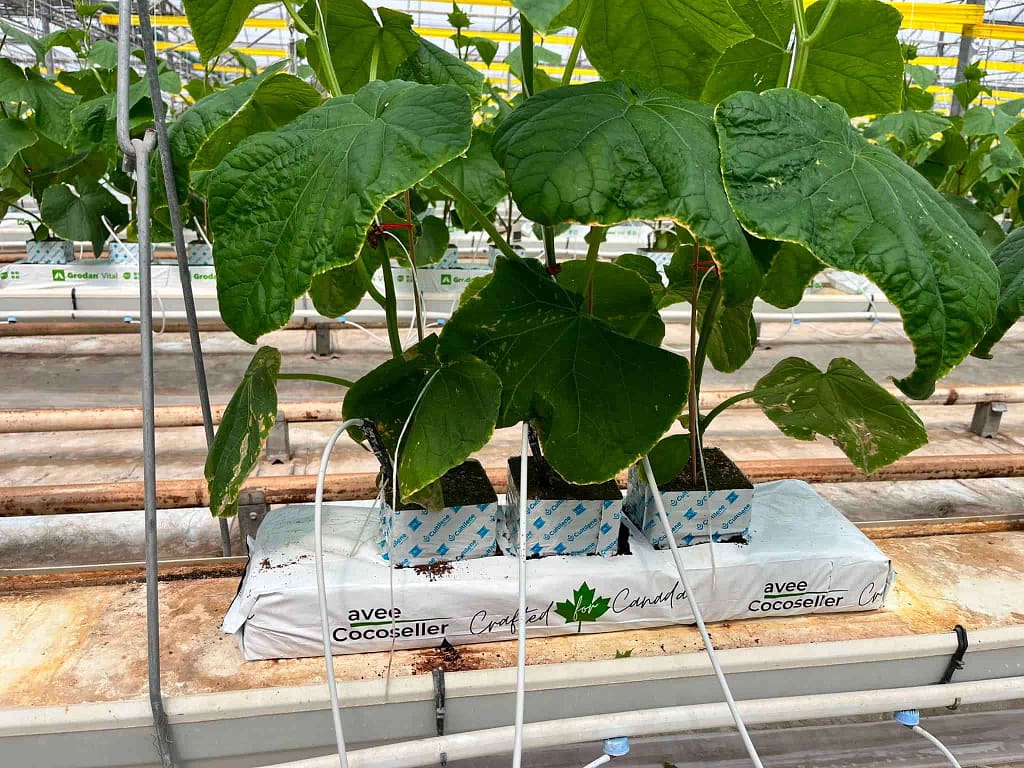
Regional Growing Conditions in Grande Prairie, Alberta
Grande Prairie’s sunshine hours and agricultural labour pool are two of the region-specific factors an Alberta substrate supplier has to account for when quoting coco coir grow bags and compressed blocks for northern greenhouse and modular CEA builds.
Grande Prairie’s economic development plan lists greenhouse and vertical agriculture among its priority investment sectors, and Northwestern Polytechnic runs a smart-agriculture research program in the region — evidence that controlled-environment production is an active area of local investment, not just a future possibility.
Modular and container-based hydroponics are already operating here: New Horizon Co-operative runs a Growcer-built modular hydroponic unit — its “Local Garden” facility, which arrived in October 2021 — growing leafy greens for the co-op’s own shelves. We cite it only as evidence that the modular CEA production model is real and active in this market, not as an A-Vee customer or partner. As an Alberta substrate supplier, A-Vee ships coco coir grow bags and compressed coco coir — also called coco peat — in bulk to growers testing or scaling these systems across the province, with EC and pH documentation available on request.
Root-Zone Media for a Short-Season, Long-Daylight Growing Plan
Engineered growing cycles — lighting, heating, and irrigation run on a fixed plan — push substrate consistency to the top of what’s left to standardize. Compressed coco coir’s known dimensions and expansion ratio make it straightforward to plan irrigation volumes, fill weights, and per-unit root-zone volume before a pilot module or bench system goes into production.
Coco Coir Grow Bags and Compressed-Block Options
Pith and chips are also available as separate components, useful for propagation trays and modular-unit inserts where a custom blend ratio suits the system better than a pre-blended bag.
| Format | Specification | Best fit |
|---|---|---|
| 5 kg compressed block | ~30×30×12 cm, ~70–75 L expanded, ~5:1 ratio | On-site fill for benches/modular trays; most freight-efficient over long-haul routes |
| Coco coir grow bags | ~70% pith / 30% chips | Ready-to-plant bag/slab culture, no mixing step |
Coir Blend and Particle-Size Considerations
Pith drives water retention; chips hold pore space for oxygen. The ratio between the two affects how a blend performs across propagation trays, modular hydroponic inserts, and bench systems, so it’s worth confirming the blend against your specific setup before ordering.
Material specification for our open-top grow bags is pending final verification before being cited in a purchase order — confirm directly with A-Vee if your program uses this bag style.
EC and pH Documentation for Coco Coir and Coco Peat
- Format5 kg compressed coco coir block
- Compressed dimensions~30 × 30 × 12 cm
- Expanded volume~70–75 litres
- Compression ratio~5:1
- ECBelow 0.5 mS/cm*
- pH range5.5–6.5
*Subject to applicable test method. Ask for the figures relevant to your order as part of a quote request — useful before a trial batch enters a research plot, modular unit, or commercial bench run.
From Trial Quantity to Commercial Volume
Whether you’re trialling a single pallet or moving to bulk coco coir wholesale volumes across a multi-bench build-out, the process stays the same:
- Discuss your requirement with our team
- Confirm the format and specification that fits your system
- Trial a smaller quantity before you scale
- Move to commercial ordering once the format is confirmed
- Freight and availability confirmed per postal code each time
- Documentation provided for propagation, modular, or bench trials
Northern Alberta Freight Inquiry
A-Vee’s Canadian HQ is in St. Catharines, Ontario, with a confirmed warehouse in Cambridge, Ontario. Freight into northern Alberta depends on product mix, order volume, pallet configuration, and your exact delivery postal code — it isn’t estimated until those details are confirmed.
Pollachi & Peravurani, Tamil Nadu
Coco coir sourced through our supply chain in Pollachi and Peravurani, Tamil Nadu.
St. Catharines, Ontario
A-Vee’s Canadian operations are based in St. Catharines, Ontario.
Cambridge, Ontario
Stocked and dispatched from our warehouse in Cambridge, Ontario.
We don’t operate a facility in Grande Prairie or the Peace Country — we supply on a delivered basis, with availability and freight confirmed for your specific postal code. Compressed blocks ship more finished-litres-per-pallet than pre-expanded material, which is worth factoring into a freight comparison for a long-haul route.
Questions From Grande Prairie CEA and Greenhouse Buyers
We’re piloting a modular/container unit, not a full greenhouse — do you supply at that scale?
Yes — compressed blocks suit smaller systems, including modular and container hydroponic units. Tell us your unit size and format preference when you request a quote.
How does the ~5:1 compression ratio affect a long-haul order into the Peace Country?
Compressed blocks pack more finished substrate per pallet than pre-expanded material, which is worth factoring into a freight comparison. Ask for a comparison quote for your postal code.
Can we order a trial quantity before committing to a full pallet?
Yes — discuss sizing with our team. Availability and minimums depend on format and current production schedule.
Compressed block or ready-to-use grow bag — which should we start with?
Grow bags (~70% pith / 30% chips) are ready-to-plant with no mixing step, while 5 kg compressed blocks give full control over blend and hydration timing for on-site fill. Either can work for a pilot module; tell us your setup for a recommendation.
Is EC/pH information provided with an order?
Yes — EC below 0.5 mS/cm and pH 5.5–6.5, subject to the applicable test method. Ask for the figures relevant to your order when you request a quote.
How is delivery to Grande Prairie confirmed?
Per postal code, order volume, and pallet configuration at quote time — we don’t publish fixed delivery timelines in advance.
Request a Delivered Quote
Tell us about your operation and we’ll follow up with a delivered quote for your postal code.
Prefer another channel? Use our contact page or message us on WhatsApp.
Related Coco Coir Resources
Plan a Commercial Coir Order for Your Grande Prairie Project
Compressed blocks and grow bags — sourced through our supply chain in Pollachi and Peravurani, Tamil Nadu, with Canadian operations based in St. Catharines, Ontario and a warehouse in Cambridge, Ontario.
Request a Delivered Quote