 Skip to main content
How to reuse coco coir grow bags
A risk-based guide to cleaning, EC testing, sanitation, physical inspection and reconditioning between commercial crops.
Reusing coco coir can reduce media purchases and disposal volume, but a second crop should never begin on assumption alone. Used coir must be evaluated for disease history, physical breakdown, salt accumulation and irrigation uniformity before it returns to production.
This guide explains how to reuse coco coir in grow bags, slabs and containers. It is written for commercial greenhouses, nurseries and controlled-environment growers in Canada and the United States.
Can coco coir be reused?
Yes, high-quality coir can sometimes support another crop because coconut fibre breaks down relatively slowly. However, reuse is a production decision—not a guaranteed property of every bag.
University of Florida guidance notes that solid greenhouse media may be reused when properly sterilized, but it also warns that water conductance and aeration can become inconsistent among older slabs or bags. Reusing unsterilized media carries disease risk. The potential saving must therefore be weighed against crop value, labour, sanitation capacity and the history of the previous root zone.
When not to reuse coco coir
Discard or divert used coir away from production when any of the following applies:
- The previous crop had confirmed or suspected Pythium, Phytophthora, Fusarium, Rhizoctonia, bacterial wilt or plant-parasitic nematodes.
- Bags are crushed, torn, permanently compacted or draining unevenly.
- Roots have formed dense mats that cannot be removed without destroying the substrate structure.
- Persistent odour, slime, algae or anaerobic zones remain after cleanup.
- Representative samples show large EC, pH or moisture differences that cannot be corrected uniformly.
- The next planting is a high-value crop for which a sanitation failure would cost more than replacement media.
Do not mix questionable material into clean material. Segregate lots by house, crop, cultivar and disease history so one problem batch does not compromise the rest.
A seven-step coco coir reuse workflow
1. Record the crop history
Before removing plants, document crop health, root appearance, irrigation problems, pest pressure and any laboratory diagnoses. Healthy white-to-cream roots and uniform drainage support further evaluation; brown, soft or foul-smelling roots require investigation.
2. Inspect bags and substrate structure
Check sleeves, seams, planting holes and drain cuts. Compare bag height and firmness across the row. A bag that has collapsed or developed channels may no longer distribute water predictably, even if its chemistry can be corrected.
Open a representative sample from the beginning, middle and end of irrigation lines. Look for fine-particle migration, hard layers, dry pockets and dense root mats.
3. Remove plants and root debris
Remove stems and the main root crown without tearing the bag unnecessarily. Loose coir can be screened to remove larger roots. In sealed grow bags, mechanical root removal may be limited; forcing out every fine root can damage the pore structure more than it helps.
Organic material interferes with many sanitizers. Clean production surfaces, tools, drippers and drainage channels separately before disinfection. NC State Extension recommends removing soil or media debris from surfaces before applying a sanitizer.
4. Test EC and pH consistently
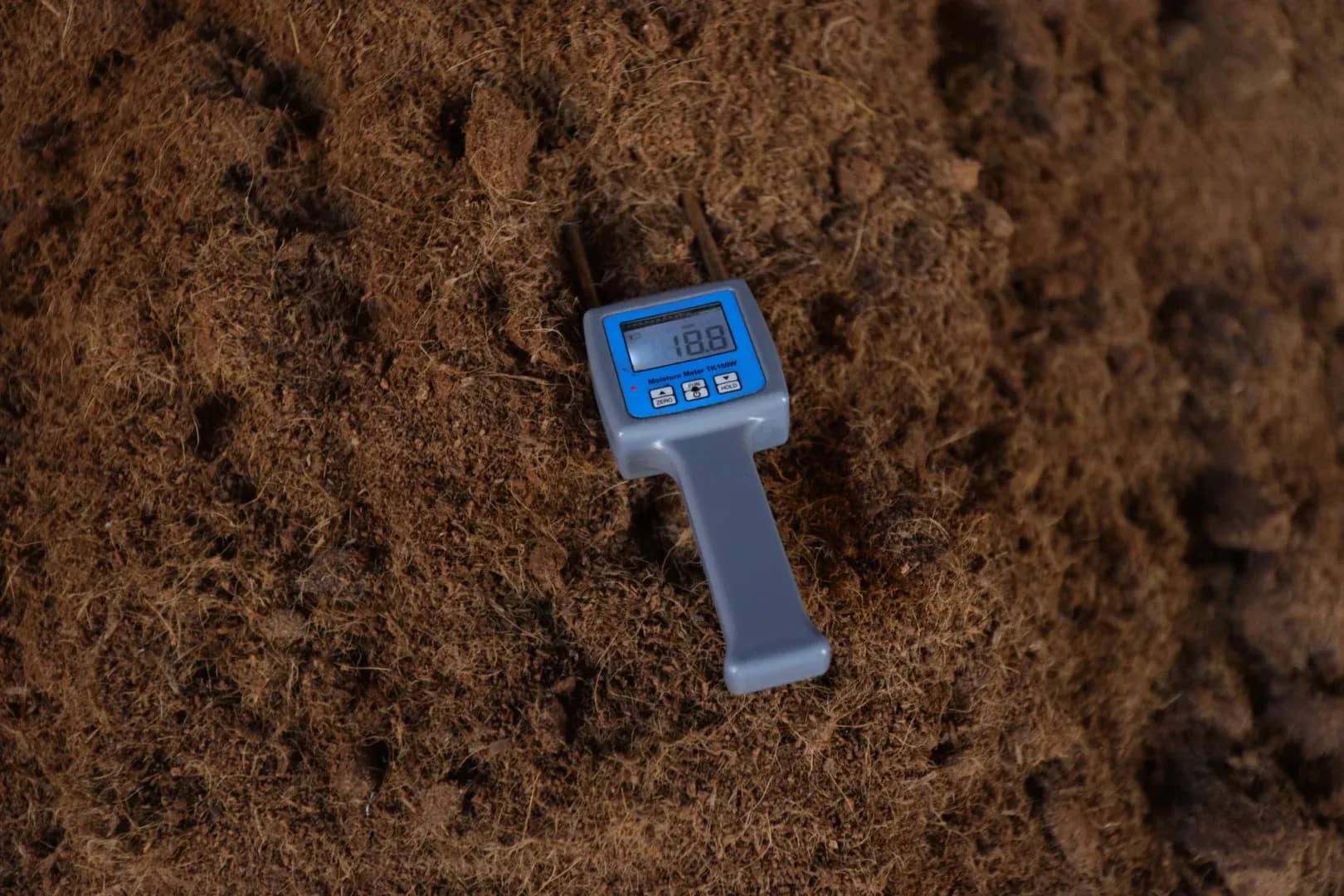
Electrical conductivity indicates the concentration of dissolved ions, while pH affects nutrient availability. Neither number should be interpreted without the test method.
- Select representative bags—not only the wettest or easiest to reach.
- Sample the same root-zone depth and position from each bag.
- Use one documented extraction method consistently, such as the method specified by your laboratory or crop program.
- Calibrate EC and pH meters before testing.
- Compare the results with the next crop’s specification and with new coir tested using the same method.
A runoff reading can help monitor an operating crop, but it is not automatically equivalent to a laboratory substrate extraction. Avoid comparing results produced by different methods.
5. Flush only when the data supports it
If soluble salts are elevated, apply clean water or an approved corrective solution uniformly and collect drainage until the trend stabilizes within the target established for the next crop. Record the volume used and test several bags again.
Flushing cannot correct damaged structure, pathogens or a blocked drainage pattern. If some bags require far more water than others to reach a similar EC, the lot may no longer be uniform enough for commercial reuse.
6. Sanitize with a validated process
Sanitation is the most important risk point. Steam is a recognized method for treating reusable solid media, provided the entire substrate mass reaches the validated time and temperature required by the operation’s protocol.
Chemical products containing chlorine, quaternary ammonium compounds, hydrogen peroxide/peroxyacetic acid or other active ingredients may be registered for particular greenhouse surfaces, equipment or irrigation systems. That does not mean every product is approved or effective for treating porous growing media.
7. Recondition and verify before planting
After treatment, rehydrate representative bags with the intended starter solution and allow them to drain. Confirm:
- Uniform hydrated volume and bag height
- Acceptable EC and pH using the chosen method
- Comparable input and drainage across emitters
- No blocked drain holes or persistent saturated zones
- No sanitizer residue outside the permitted re-entry or planting conditions
Run a small trial before committing an entire greenhouse. Compare reused and new bags under the same crop and irrigation program.
Does used coco coir need rebuffering?
Not automatically. “Rebuffering” should not be a ritual performed without measurement.
Coir has cation-exchange sites that interact with calcium, magnesium, potassium and sodium. A previous crop, flushing process and source water can change the chemical balance. The correct restart solution therefore depends on substrate analysis and the next crop’s nutrient program.
If testing or crop advice indicates that calcium conditioning is required, apply a coir-appropriate nutrient or buffering protocol and verify the result. Do not assume that adding an arbitrary quantity of Cal-Mag proves the substrate is ready.
How to test whether reused bags still irrigate uniformly
The companion coco coir irrigation and runoff EC guide explains how to track input, drainage and dryback after planting.
Canada and USA: sanitation decisions differ by operation
Cold Canadian winters do not sanitize a greenhouse bag automatically, and hot U.S. summers do not guarantee that the centre of a substrate mass reaches a lethal temperature. Climate can help or hinder drying, but it is not a substitute for a validated treatment.
Canadian and U.S. operations must also follow the pesticide, worker-safety, wastewater and disposal rules that apply in their province or state. Product registrations and permitted uses can differ across the border. Confirm local requirements before applying any chemical treatment or discharging flush water.
Reusing versus replacing: a commercial decision
End-of-life options for coco coir
When coir is no longer suitable for controlled production, it may still be useful as a soil amendment, compost component or landscaping material if it is free of regulated pests, pathogens and prohibited residues. Remove plastic sleeves, clips and irrigation hardware first.
Do not move diseased media to outdoor beds or compost where pathogens could spread. Follow municipal, provincial/state and plant-health requirements for disposal.
Coco coir reuse checklist
- Previous crop and disease history documented
- Bags inspected for tears, crushing and compaction
- Roots and organic debris removed as far as practical
- Representative EC and pH tests completed
- Physical uniformity and drainage checked
- Validated sanitation decision documented
- Restart nutrition or buffering based on testing
- Small trial compared with new media
- Unsuitable coir separated for safe disposal or recycling
Frequently asked questions
How many times can coco coir be reused?
There is no guaranteed number. Some structurally sound coir can support an additional crop, but disease history, compaction and irrigation variability determine whether reuse is sensible. Evaluate the bags before every cycle.
Can I reuse coco coir without sterilizing it?
Reusing unsterilized greenhouse media carries disease risk. The appropriate sanitation method depends on the crop history, production system and applicable regulations. High-value commercial crops require a conservative decision.
Can hydrogen peroxide sterilize coco coir?
Peroxide-based products are used for certain greenhouse sanitation applications, but effectiveness and legal use depend on the specific product, concentration, contact time and target. Do not improvise a recipe or assume a surface-disinfectant label covers porous growing media.
Should I remove every old root?
Remove the crown and as much large root material as practical. Aggressive processing that destroys the coir structure can make irrigation less uniform. Persistent dense root mats are a reason to replace the media.
What EC should reused coco coir have?
Use the specification for the next crop and the chosen test method. A universal threshold is misleading because extraction methods and crop tolerances differ. Compare reused material with new material tested using the same procedure.
Need fresh grow bags for the next crop?
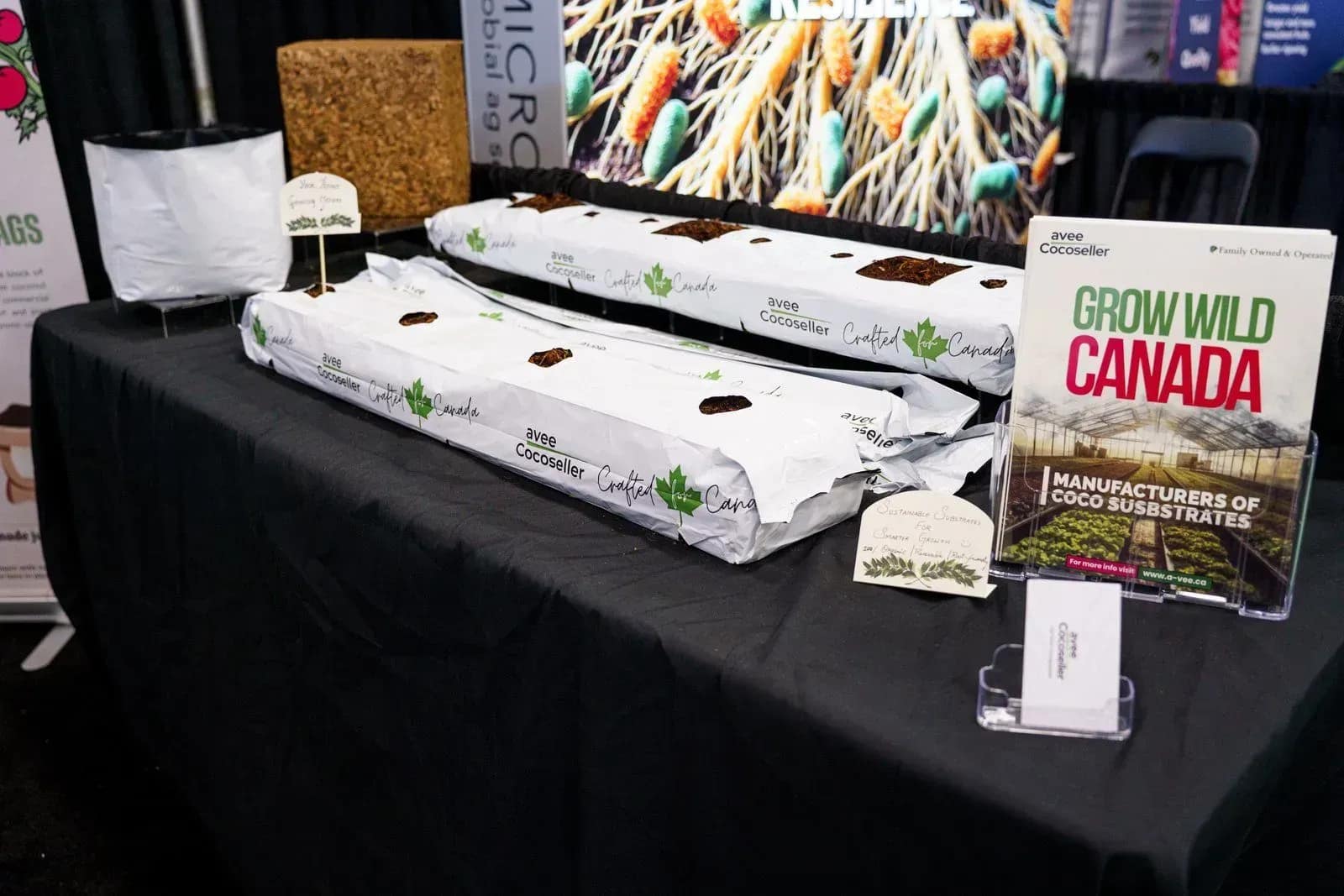
If a reuse audit shows excessive compaction, disease risk or chemical variability, replacement is usually less expensive than a failed crop. Avee supplies commercial coco coir grow bags, open-top bags and 5 kg coco coir blocks to growers across Canada and the USA.
Compare reuse risk with replacement cost
Send Avee the crop, bag dimensions, quantity and delivery location for a replacement-media quotation.
Technical references
- University of Florida IFAS Extension: Greenhouse Management for Vegetable Production in Solid Media
- NC State Extension: Prevention and Management of Soilborne Greenhouse Diseases
- University of Florida IFAS Extension: Common Media Used in Hydroponics
- UMass Extension: Root Diseases of Greenhouse Crops
- University of Missouri IPM: Sanitizing Greenhouses
This guide provides general production information. Sanitation products and processes must be validated for the crop, pathogen, equipment and jurisdiction involved.