 Skip to main content
- Home
- About
-
Grow mediaCoco peat blocks Bulk loose coir pith Coco husk chipsGrow bagsCoir grow bags Open-top grow bagsPropagationSeed starter pellets Propagation cubes Coir fibre bales View all products →
-
By cropCannabis Tomatoes StrawberriesBy applicationGreenhouse Horse bedding Mushroom substrate All solutions →
Peat Moss Restrictions Are Reshaping Growing Media
If you’ve bought growing media in the UK or EU recently, you’ve likely noticed the shelves shifting. Peat-based composts are being phased out of professional horticulture on a fixed government timeline, and major buyers — from the Royal Horticultural Society to large retail nurseries — have already gone peat-free ahead of the legal deadline. For growers sourcing substrate internationally, or simply watching where the industry is heading, that shift matters even if you’re not directly affected by UK law.
But the full picture is more regional than the headlines suggest. Canada — where the coco coir in this article’s own supply chain doesn’t originate, but where a huge share of the world’s horticultural peat does — isn’t banning anything. It’s the largest peat producer and exporter on earth, and its industry association makes a detailed sustainability case for continuing to extract it. Both things are true at once, and growers deserve the accurate version, not the simplified one.
The UK and EU Timeline, Accurately
The UK’s peat phase-out has moved in stages, and the dates are worth getting right since they’re frequently reported inconsistently:
Some professional buyers aren’t waiting for the deadline. The RHS stopped selling peat-based compost in 2019 and, as of January 2026, sources all plants sold at its garden centres as “no new peat.” That’s a voluntary, ahead-of-schedule move — a signal that buying preferences in these markets are shifting faster than the law strictly requires.
Why Peatlands Are the Focus
The environmental case against peat extraction centers on carbon, not just habitat. Peatlands are dense, long-term carbon stores — when drained or harvested, that stored carbon is released rather than staying locked underground for centuries. UK campaigners and government reviews have pointed to this as the primary reason the restrictions exist at all, separate from any question of whether alternatives perform as well in cultivation.
Where Canada’s Peat Industry Actually Stands
This is the part that gets flattened in most “peat is being banned” coverage: Canada is not moving toward a ban. It’s the world’s largest producer and exporter of horticultural peat moss, supplying more than 98% of the Canadian Sphagnum peat used in the US market. The Canadian Sphagnum Peat Moss Association (CSPMA) — representing roughly 95% of national production — makes a specific, numbers-based sustainability case rather than disputing the science on carbon storage:
Extraction footprint: the entire Canadian peat industry’s cumulative footprint since the 1930s is 36,032 hectares — about 0.03% of the country’s 119 million hectares of peatlands.
Restoration commitment: extracted sites are certified under the third-party Veriflora Responsibly Managed Peatlands program, with a stated goal of ecological restoration after harvesting.
Regulatory framing: the CSPMA argues peat extraction is already subject to strict provincial regulatory frameworks, and that natural peat accumulation nationally exceeds industry extraction by a wide margin each year.
We’re not the ones positioned to referee that dispute — reasonable people, including credentialed ecologists, disagree on how to weigh a small extraction footprint against the fact that peatlands, once drained, take centuries to recover if they recover at all. What we can say plainly: if you grow in Canada or the US, nothing legally requires you to leave peat behind. The pressure to consider alternatives is coming from buyer preference and export-market shifts, not domestic regulation.
Coco Coir as the Practical Alternative
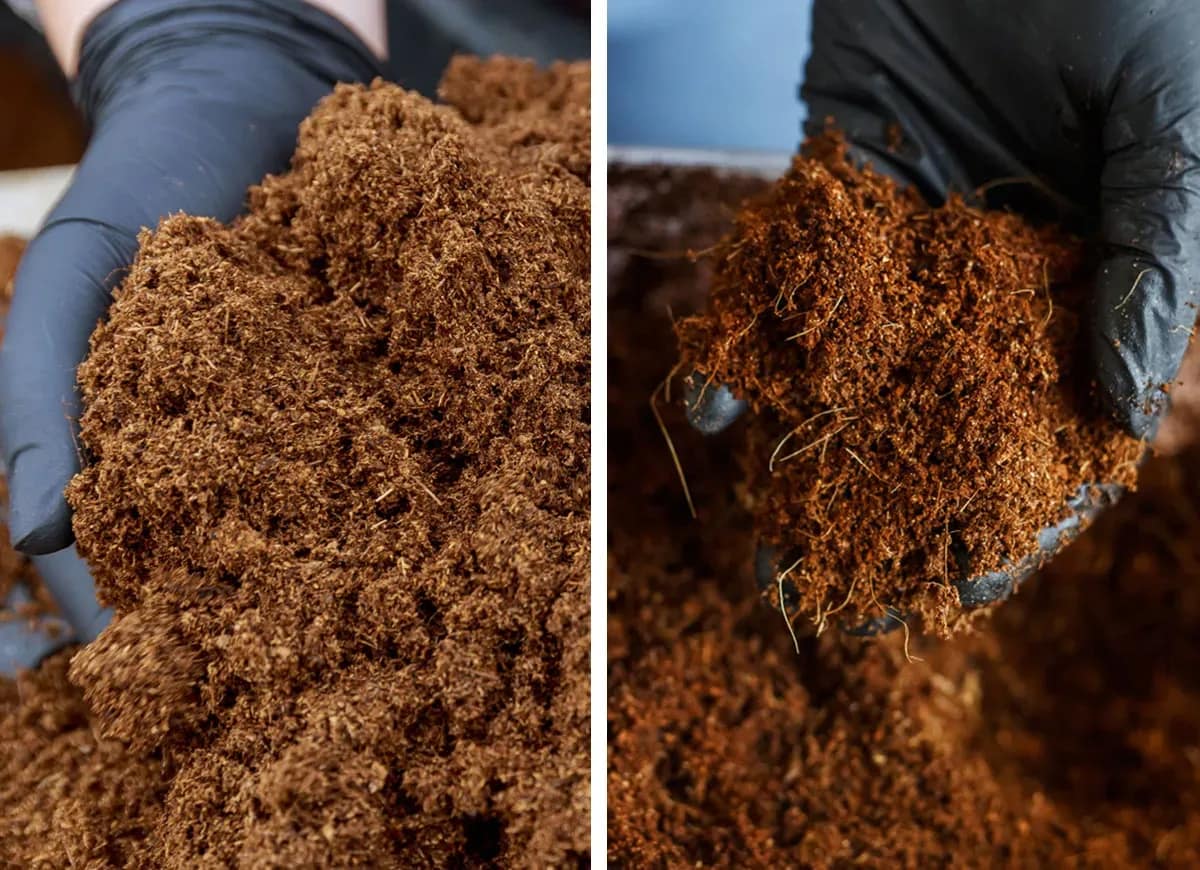
Whether the motivation is a UK export relationship, a retail buyer’s sustainability policy, or simply wanting a substrate with different handling properties, coco coir is the alternative most commonly adopted in place of peat. It’s a byproduct of coconut processing — mechanically separated from husks already being processed for food and fibre — rather than an extracted, slow-to-regenerate resource.
Growing Characteristics
- Naturally acidic (pH 3.5–4.5), needs lime amendment
- Very low native EC
- Can compact and become hydrophobic when it dries out
- Slow to rehydrate once fully dried
- Sourced by extraction from a wetland ecosystem
Growing Characteristics
- Near-neutral pH (5.5–6.5) out of the bag
- Higher native EC — requires proper washing and buffering
- Rewets easily even after fully drying out
- Reusable for 2–3 growing cycles before composting
- Byproduct of existing coconut processing, not extracted
Coco isn’t a drop-in swap — it behaves differently enough that switching without adjusting your program will cause real problems, particularly around calcium and magnesium availability. That’s the part growers actually need practical guidance on, not the politics.
If You’re Switching From Peat to Coco, Here’s the Sequence
Confirm the coco is pre-washed and buffered
Unbuffered coco coir carries residual salts and unlocked cation exchange sites that will lock out calcium and magnesium from your feed. Ask any supplier for EC and buffering documentation before you order.
Adjust your Cal-Mag program from day one
Even properly buffered coco benefits from supplemental calcium and magnesium in your feed schedule — peat generally doesn’t need this the same way.
Recalibrate your irrigation frequency
Coco holds and releases water differently than peat. Expect to irrigate more frequently in smaller volumes rather than peat’s typical deep-and-infrequent schedule.
Run a side-by-side trial before switching entirely
Commercial operations rarely switch every bench at once. A partial trial across one crop cycle catches supplier-specific quality issues before they affect your full operation.
Common Questions
No. There is no peat ban in Canada or the US. The restrictions covered in this article apply to the UK, with similar regulatory pressure building in parts of the EU. Canada remains the world’s largest peat producer and exporter.
Mainly buyer preference and export relationships — retailers and brands with UK or EU customers are adjusting sourcing to match those markets’ standards, and some growers simply prefer coco’s handling properties regardless of regulation.
For most crops, yes, once your feed program accounts for coco’s different EC and Cal-Mag behavior. It isn’t a neutral substitute you can drop in unchanged — it’s a different substrate that needs its own management approach.
The Shift Is Real, But It’s Regional — Plan Accordingly
If your business touches UK or EU buyers, the 2026 professional-use deadline is a real planning constraint, not a distant possibility. If you grow exclusively for the Canadian or US domestic market, you’re not legally affected — but coco coir remains a legitimate substrate choice on its own merits, provided you buy from a supplier that properly washes and buffers it. See our buffered vs. unbuffered coco coir guide before you order your first pallet.
Factory-Direct Coco Coir, Pre-Buffered — batch documentation on request
Triple-washed, calcium-buffered coco coir shipped from our Ontario warehouse to Canada, USA & Mexico — no distributor markup.