
- Home
- About
-
Grow mediaCoco peat blocks Bulk loose coir pith Coco husk chipsGrow bagsCoir grow bags Open-top grow bagsPropagationSeed starter pellets Propagation cubes Coir fibre bales View all products →
-
By cropCannabis Tomatoes StrawberriesBy applicationGreenhouse Horse bedding Mushroom substrate All solutions →
Planning a Coco Coir Order for Nanaimo and Central Vancouver Island
Central Vancouver Island’s growing land base is fixed rather than expanding, and operators skew older. Many operations are modernizing within that fixed footprint rather than adding acreage, and coco coir is often part of that shift. We don’t hold stock in British Columbia, and we don’t promise a delivery date on this page — freight depends on format, order size, pallet configuration, and your delivery postal code.
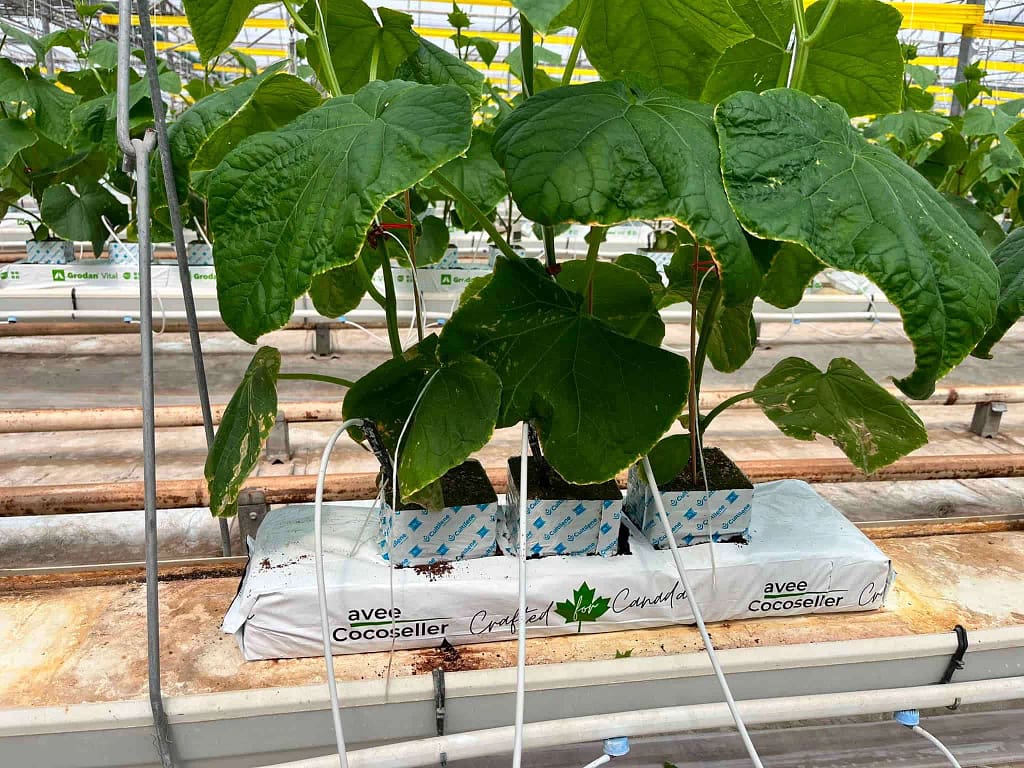
A British Columbia Substrate Supplier for a Land-Constrained Region
The Regional District of Nanaimo’s Agricultural Land Reserve is fixed rather than expanding, and the average producer here is 60 — so most near-term growth comes from intensifying existing operations, not adding acreage. The region’s own growth strategy anticipates a longer, warmer growing season ahead and explicitly supports value-added and urban agricultural initiatives, both of which favour container and bag-culture systems over field expansion. That combination of a fixed land base and an aging operator group is part of why growers here work with us as a British Columbia substrate supplier, sourcing coco coir wholesale rather than a single truckload at a time.
Dairy, nursery, and floriculture already generate more than 48% of farm receipts across the wider Vancouver Island-Coast region, reflecting how much of this island economy runs on protected, controlled-environment growing rather than open field crops. Bag-culture operations here typically start with coco coir grow bags or buffered coco coir, pre-treated to release calcium and magnesium rather than bind it, while propagation and retail operations more often work from compressed coco peat blocks. Whatever the format, we confirm exact freight to your Vancouver Island postal code at the quote stage.
Who the Available Coir Formats Are For
Greenhouse / Container Bag-Culture
Pith-and-chip grow bags.
Nurseries / Propagation
Finer pith grade.
Garden Centres / Landscape Suppliers
Retail-format compressed blocks.
Institutional / Community Projects
Trial quantities first, then repeat orders.
Order-Consolidation Worksheet for Bulk Coco Coir
| Question | Why it matters |
|---|---|
| What are you growing, and in what system? | Determines format |
| First trial or repeat commercial order? | Affects sizing and freight economics |
| Target expanded (usable) volume in litres? | Compressed product ships by weight/count, not expanded volume |
| Single delivery or recurring order cycle? | Recurring orders may consolidate freight |
| Exact delivery postal code? | Ferry/barge-served, rural, and business-zoned addresses price differently |
| Forklift/dock/manual offload at site? | Matches pallet-scale orders to receiving capability |
| Horticultural purchase or distributor/reseller inquiry? | Routed differently |
Expanded-Volume Planning
A block ships ~30×30×12 cm / 5 kg, rehydrates to ~70–75 L at ~5:1 — work backward from your target expanded volume to estimate block count, and confirm the exact case/pallet configuration at quote stage. For grow bags, match bag volume to your container/slab-culture spacing before finalizing quantity.
Product Specification Cards
- Compressed dimensions~30 × 30 × 12 cm
- Expanded volume~70–75 L
- Compression ratio~5:1
- ECBelow 0.5 mS/cm*
- pH range5.5–6.5
- Grow-bag blend~70% pith / 30% chips
This page intentionally does not publish a minimum order quantity — MOQs are confirmed at quote stage.
Destination and Receiving Considerations
Vancouver Island deliveries add a mainland-to-island freight leg — exact postal code, receiving capability, and trial-vs-recurring status all matter. No fixed delivery timeline is published.
Sourced in Tamil Nadu, Delivered From Ontario
Submit Worksheet Answers
Format, quantity, destination.
Confirm Fit & Freight
Product fit and destination freight confirmed.
Receive a Delivered Quote
Covering product and island freight.
No warehouse or stock on Vancouver Island — A-Vee is headquartered in St. Catharines, Ontario, with a confirmed warehouse in Cambridge, Ontario, and coir production associated with Pollachi and Peravurani, Tamil Nadu.
Island-Order FAQ
Warehouse or stock on Vancouver Island?
No.
Guaranteed delivery date?
No — confirmed as part of the quote.
Compressed blocks vs. grow bags?
As above — see the format list.
Small trial quantity possible?
Yes — flag it.
Resale/distribution inquiries?
Handled distinctly — note it in your inquiry.
What EC/pH should I expect?
Below 0.5 mS/cm (method-qualified), pH 5.5–6.5.
Minimum order quantity?
Not published — confirmed at quote stage.
How do I plan block/bag count?
Use the expanded-volume planning section above.
Request a Delivered Quote for Your Postal Code
Tell us about your operation and we’ll follow up with a delivered quote.
Related Coco Coir Resources
Consolidate Your Nanaimo Coir Order
Compressed blocks, grow bags, and pith/chip blends — sourced through our supply chain in Pollachi and Peravurani, Tamil Nadu, with Canadian operations based in St. Catharines, Ontario and a warehouse in Cambridge, Ontario.
Request a Delivered Quote