
- Home
- About
-
Grow mediaCoco peat blocks Bulk loose coir pith Coco husk chipsGrow bagsCoir grow bags Open-top grow bagsPropagationSeed starter pellets Propagation cubes Coir fibre bales View all products →
-
By cropCannabis Tomatoes StrawberriesBy applicationGreenhouse Horse bedding Mushroom substrate All solutions →
Coco Coir for Kamloops, BC: Matching Growing Media to Your System
Greenhouse bag culture, container nursery stock, and rooftop or community-garden-scale food production all put different demands on a growing medium. Before comparing suppliers, most Kamloops-area operations get further by comparing formats: how much water the medium holds, how much air stays available to the root zone, and how that changes with irrigation schedule.
British Columbia Substrate Supplier for Kamloops-Area Growers
Kamloops’ 2015 Food and Urban Agriculture Plan treats growing-medium choice as part of the city’s planning framework, not an afterthought — from zoning review for greenhouses to standards for rooftop production. The figures below come directly from that Plan.
The Plan directs zoning review (Action 1.2.5) “to ensure regulations adequately balance the desirability of greenhouses and garden sheds,” and it explicitly defines rooftop production as containers or a green roof layer over a waterproofing membrane. It also names growing-media transparency — disclosure of soil-amendment content — as a policy concern, alongside the community gardens and water-conservation items cited above.
A-Vee is not affiliated with the City of Kamloops or any local business; we reference the Plan only to describe demand context, not to claim local stock. As a British Columbia substrate supplier working on a delivered basis, we don’t warehouse coco coir or coco peat in Kamloops — every order ships from Cambridge, Ontario and is quoted for your postal code.
Water-Holding Capacity vs. Air Space
Fine coco pith holds more water and drains more slowly; coarser coco chips create air pockets that drain faster. Compressed blocks (mostly pith) suit consistent water retention as a stand-alone medium or blended in. Grow bags (~70% pith/30% chips) balance moisture retention with drainage for bag-culture systems. Growers sourcing coco coir — also called coco peat — across Canada face this same trade-off; no claim is made that a particular ratio is ideal for every Kamloops grower.
Coco Coir Grow Bags, Blocks and Bulk Blends
| Format | Composition | Typical use |
|---|---|---|
| Compressed block (5 kg) | Coco pith | Potting mixes, container blends, propagation, community garden planters |
| Coco coir grow bag | ~70% pith/30% chips | Greenhouse bag culture, slab systems |
| Coco pith (loose) | Pith | Blending into existing mixes |
| Coco chips | Chips | Air space/drainage, top-dressing |
Bag material note: open-top bags may use ~40 GSM nonwoven material — confirm current spec before ordering, don’t assume from a prior purchase.
Irrigation and Fertigation Considerations
EC below 0.5 mS/cm (method-qualified), pH 5.5–6.5. Coir naturally buffers some calcium/magnesium out of solution early in use — a standard part of transitioning, worth reviewing with a crop-nutrition advisor. Pith-to-chip ratio affects irrigation frequency and leachate; re-check run times if switching from a different medium.
Greenhouse, Container and Urban-Growing Projects
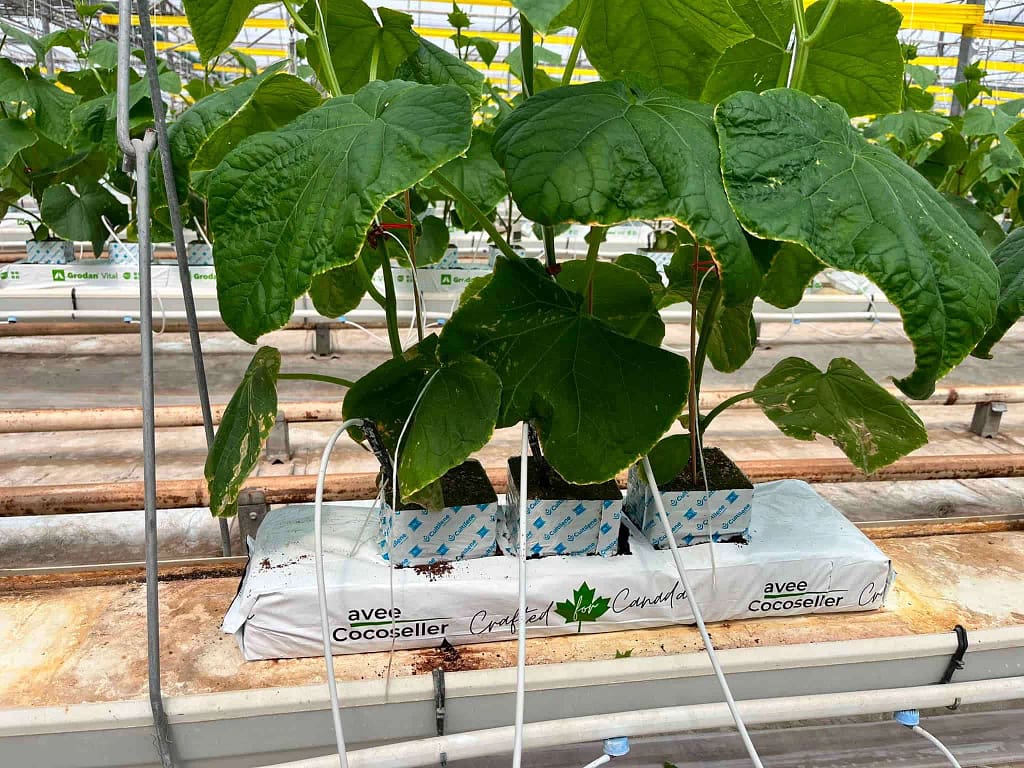
Commercial Greenhouse Bag Culture
Vine crops on drip fertigation.
Container / Raised-Bed / Rooftop
Weight-after-saturation is a real constraint — confirm with your project’s engineer.
Community Garden / Food Plots
Loose pith or blended product, available in bulk coco coir volumes for new or expanding plots.
Propagation / Nursery Supply
Fine-grade pith blends.
Product-Selection Questions
- Greenhouse, container, or rooftop system?
- Irrigation method?
- Current medium, if switching?
- Order volume?
- Documentation needed for a grant/procurement process?
Sourced in Tamil Nadu, Delivered From Ontario
Freight depends on product, format, quantity, pallet configuration, and postal code — confirmed, not published as a flat rate.
Pollachi & Peravurani, Tamil Nadu
Coco coir sourced through our supply chain.
St. Catharines, Ontario
A-Vee’s Canadian operations are based here.
Cambridge, Ontario
Stocked and dispatched from Cambridge.
No warehouse or store in Kamloops. We supply on a delivered basis, with availability and freight confirmed for your specific postal code.
Kamloops FAQ
Warehouse or store in Kamloops?
No.
Suitable for rooftop/container projects per the Plan?
Compressed blocks are compact to transport and expand on-site — but weight limits, drainage, and structural requirements should be confirmed with your project’s engineer or building department, not a growing-media supplier.
Can coir build a new community garden plot?
Yes, loose pith or blended product.
Compressed block vs. grow bags?
As above — see the format table.
Guaranteed delivery date?
No.
Specifications for a grant application?
Yes, available on request.
Request Pricing for Your Postal Code
Tell us about your operation and we’ll follow up with a wholesale coco coir quote, delivered to your postal code.
Related Coco Coir Resources
Match Your Kamloops Growing System to a Format
Compressed blocks, grow bags, and pith/chip blends — sourced through our supply chain in Pollachi and Peravurani, Tamil Nadu, with Canadian operations based in St. Catharines, Ontario and a warehouse in Cambridge, Ontario.
Request a Delivered Quote