Most Popular
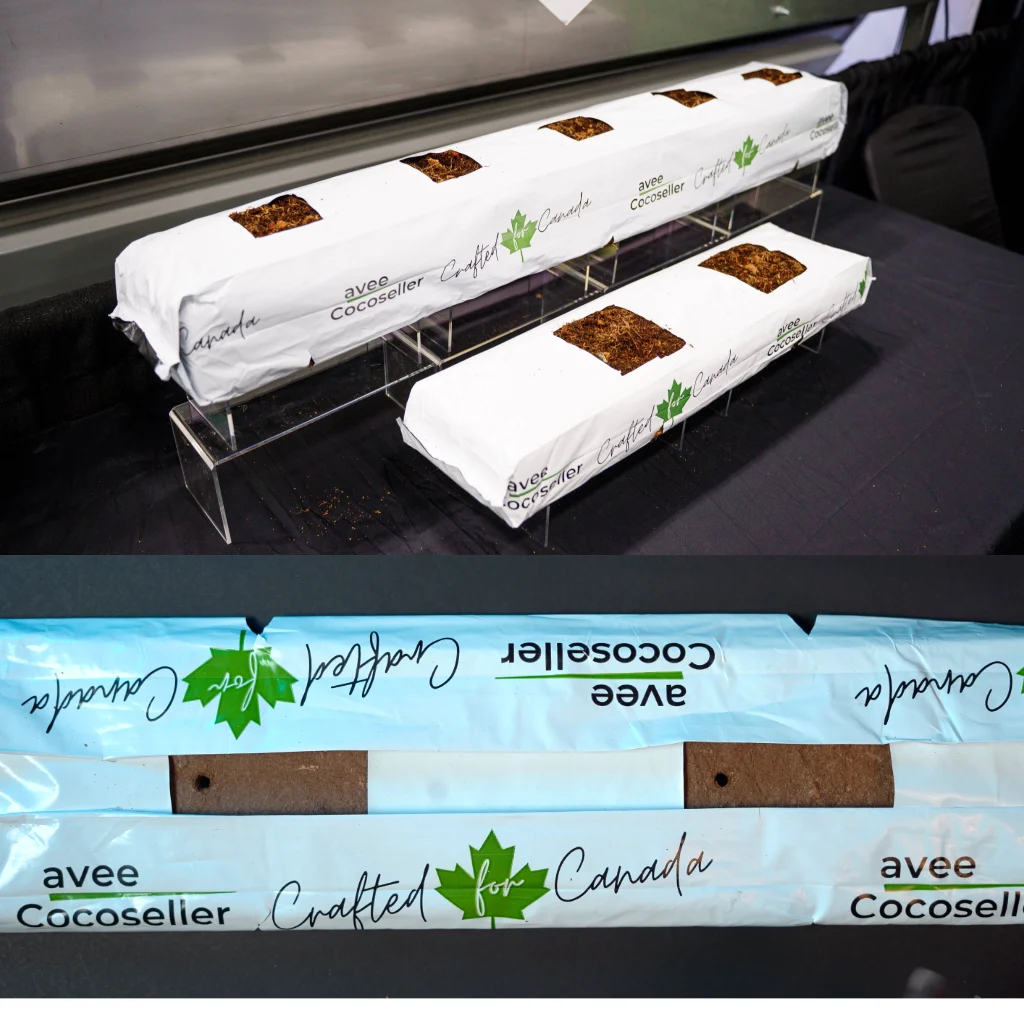
High-pith blend for stable moisture retention. EC below 0.4 mS/cm. Sized for tabletop and hanging gutter systems. 8 to 13 plants per bag. Custom dimensions for non-standard frames in BC and Ontario.
High-pith blend engineered for salt-sensitive berry root zones. Fraser Valley BC, Ontario, California and Oregon greenhouse, tabletop, and field operations. EC below 0.4 mS/cm — the critical threshold for strawberries. Pre-buffered, lab-tested, Ontario stocked.
Statistics Canada data shows greenhouse strawberry production grew from 2.6 million kg in 2020 to 7.5 million kg in 2024 — a 190% increase in four years. Area under production expanded from 303,791 m² to 839,756 m² over the same period. This is a structural shift as BC and Ontario growers move strawberry production under glass and into tabletop systems year-round.
The driver is clear. Tabletop and hanging gutter greenhouse systems eliminate soil-borne disease pressure, allow year-round production, improve labour ergonomics, and deliver better fruit quality consistency. The dominant substrate in every one of these systems is coco coir — specifically high-pith, pre-buffered, ultra-low-EC coco coir.
Sources: Statistics Canada Greenhouse Survey 2024 · Agriculture and Agri-Food Canada · AAFC Horticulture Sector Report 2024
Unlike tomatoes (EC 2.0–3.5 mS/cm) or cucumbers (EC 1.8–3.0 mS/cm), strawberry root zones cannot tolerate high salt levels. Root zone EC above 1.2 dS/m causes immediate fruit yield loss and quality loss. Your substrate must arrive at EC below 0.4 mS/cm — and it must be calcium pre-buffered so it does not strip calcium and magnesium from your feed when it contacts the root zone.
Raw unbuffered coco coir — even washed — will exchange its residual sodium and potassium ions for the calcium and magnesium in your feed solution. In tomatoes, this is manageable. In strawberries, it creates a calcium deficiency within the first two weeks that is difficult to reverse mid-season.
Whether you run tabletop greenhouse systems in BC's Fraser Valley, hanging gutters in an Ontario indoor operation, raised beds in California, or field production transitioning from peat — Avee's high-pith strawberry blend works across every system.
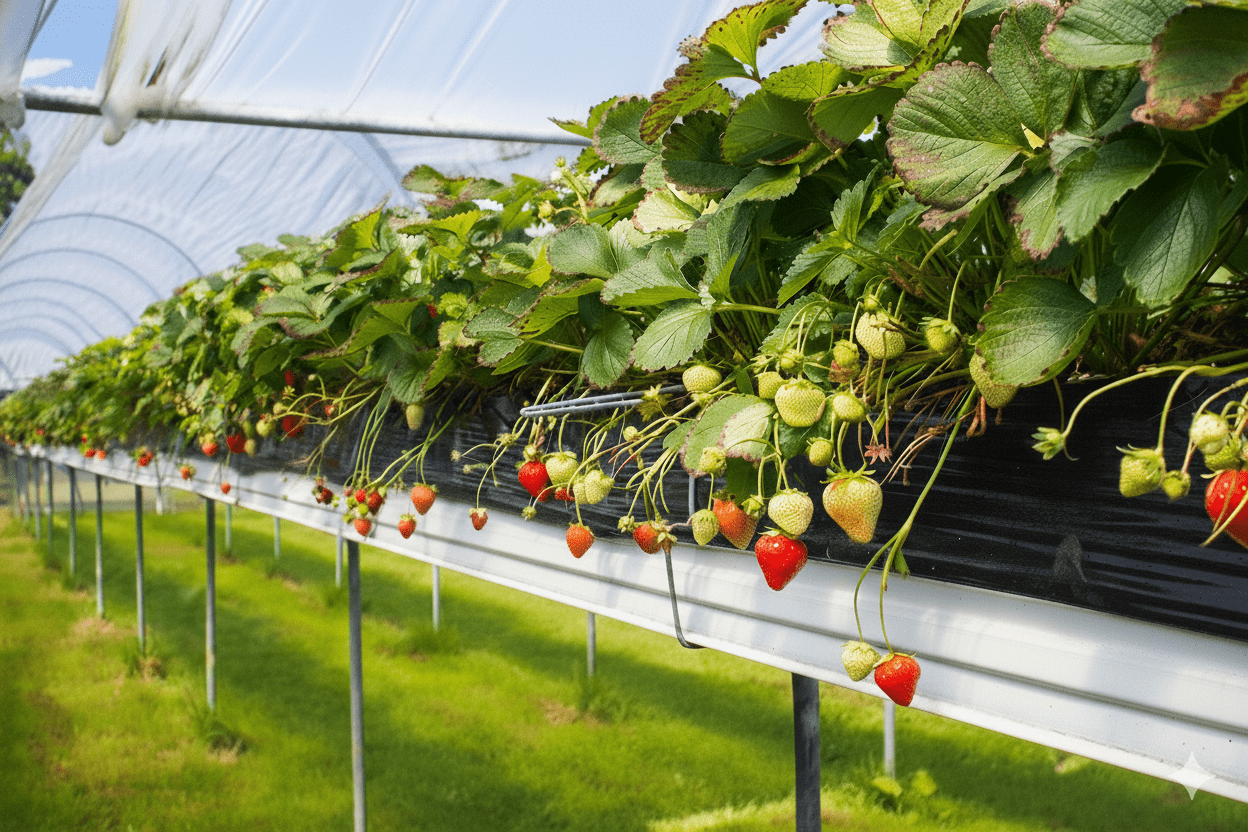
Tabletop strawberry production raises grow bags on metal frames at waist height (80 to 100cm) inside a heated greenhouse. It eliminates soil-borne disease, enables year-round production of day-neutral and everbearing varieties, and dramatically improves harvest ergonomics. This is the dominant method in BC's Fraser Valley and Ontario greenhouse operations. Coco coir's moisture retention, drainage, and light weight are ideal for tabletop gutter frames. Bags are changed every 2 to 3 seasons.
Hanging gutter systems suspend grow bags from overhead rails — stacking multiple tiers vertically to maximise production per square metre. This is popular in Ontario and BC indoor vertical strawberry operations where space is at a premium. Coco coir's light weight compared to soil or peat is a significant structural advantage in hanging configurations. It reduces load on rails and allows higher tier density without compromising structural safety.
In California and Oregon, protected outdoor strawberry production uses raised beds, plastic mulch, and low tunnel systems. Coco coir is replacing peat in these raised bed applications — offering better drainage, reuse potential, and peat-free certification. California's Watsonville-Salinas belt and Oregon's Willamette Valley both see growing demand for high-quality peat-free coco coir substrate for raised bed and substrate-filled trough production.
BC's evolving sustainability regulations are accelerating the transition away from peat-based substrates. Coco coir is the direct peat replacement — with the same moisture retention profile, superior drainage, and a renewable reusable lifecycle. For BC and Ontario strawberry operations facing ESG reporting requirements or pursuing organic certification, Avee coco coir provides a certified peat-free substrate with no performance compromise.
Every parameter that matters for commercial strawberry production — with the values that BC Fraser Valley, Ontario, California, and Oregon operations require.
← Swipe for full table| Parameter | Avee Strawberry Blend | Why It Matters for Strawberries |
|---|---|---|
| EC Level | Below 0.4 mS/cm (lab-tested) | Strawberries are the most salt-sensitive greenhouse crop. Root zone EC above 1.2 dS/m causes immediate yield loss. Substrate must arrive below 0.4 mS/cm — significantly lower than what is acceptable for tomatoes or cucumbers. |
| pH Range | 5.5 – 6.5 (stabilised) | Strawberries perform best at feed pH 5.8 to 6.2. Root zone pH above 6.5 locks out iron, manganese, and boron — causing interveinal chlorosis that is commonly misdiagnosed as a nutrient deficiency. |
| Pith:Chip Ratio | High-pith — fine blend | Strawberry root zones need stable, consistent moisture — not the rapid dry-down cycles that benefit tomatoes. High-pith coco retains moisture evenly at 60 to 75% VWC. Coarse blends drain too quickly and create moisture fluctuations that trigger premature fruit maturation. |
| Pre-Buffered | Calcium pre-buffered at source | Raw coco exchanges sodium and potassium for calcium and magnesium. In strawberries, this creates a specific calcium deficiency within two weeks of planting — causing tip burn, soft fruit, and poor shelf life. Avee coco will not rob calcium from your feed. |
| Plants per Bag | 8–13 plants per bag | Strawberry planting density is far higher than tomatoes. Standard practice: 10 to 12 plants per 15L bag for day-neutral and everbearing varieties used in Canadian and US greenhouse production. |
| Bag Volume | 11–18L (system-dependent) | Tabletop greenhouse systems typically use 15L bags. Hanging gutter systems often use smaller 11 to 12L troughs. Field raised beds use larger volumes. Contact Avee with your system type for exact sizing. |
| Moisture Retention | Excellent — stable VWC | Target VWC of 60 to 75% consistently for strawberries. Unlike tomatoes, no dryback steering is required or beneficial. High-pith coco holds this moisture range without waterlogging when drainage holes are positioned correctly. |
| Reuse Cycles | 2–3 full seasons | After sterilization with hydrogen peroxide and re-buffering with cal-mag, bags run a second and third season. For a BC tabletop operation running two crops per year, this delivers significant cost savings over single-use peat. |
| BC Peat-Free Compliance | 100% peat-free — certified | All Avee products are 100% coconut coir — a renewable agricultural byproduct. Fully compliant with BC's sustainability mandates and compatible with organic certification schemes in both Canada and the USA. |
The complete setup workflow for commercial strawberry operations in Canada and the USA — with the strawberry-specific details that matter at the root zone level.
Most Canadian strawberry growers still use peat — either in field production or early tabletop systems. Here is why the switch to coco coir is accelerating, and why Avee's pre-buffered substrate makes the transition straightforward.
← Swipe for full table| Factor | Avee Coco Coir | Peat Moss | Rockwool |
|---|---|---|---|
| Starting EC | Below 0.4 mS/cm — berry safe | Variable — often too high | Near zero |
| Moisture Retention | Excellent — stable VWC | Good | Poor — dries too fast |
| Pre-Buffered for Ca/Mg | Calcium pre-buffered at source | Not buffered | Not applicable |
| Reusable | 2–3 seasons | Single use | Single use |
| 100% Peat-Free | Renewable coconut byproduct | Is peat | Synthetic fibre |
| BC Peat-Free Compliance | Fully compliant | Non-compliant | Synthetic waste |
| Weight for Tabletop Systems | Lightweight — less rail stress | Heavier when saturated | Light |
| Ontario Stocked — Ships Fast | Same-week Canada and USA | Regional only | Import delays |
| Calcium Robbery Risk | None — pre-buffered | High — strips Ca/Mg | None |
Most Popular
High-pith blend for stable moisture retention. EC below 0.4 mS/cm. Sized for tabletop and hanging gutter systems. 8 to 13 plants per bag. Custom dimensions for non-standard frames in BC and Ontario.
Open-top bags for hanging gutter systems and vertical setups. Exposed coir surface supports even moisture distribution across the full bag width — critical for the high-density planting of 8 to 13 plants per bag used in strawberry production.
For raised bed and field strawberry production — blend 10 to 20% husk chips into high-pith coco for improved drainage in outdoor applications. Prevents waterlogging in heavy-rain California and BC field conditions without sacrificing the moisture retention strawberry roots need.
Same-week dispatch to every major strawberry production region in Canada and into key US states — from Cambridge, Ontario.
BC's Fraser Valley — Abbotsford, Chilliwack, Surrey, Langley, Delta — is Canada's highest-value strawberry producing region. With BC's peat-free sustainability push accelerating adoption of coco coir substrates, Avee ships same-week from Ontario to BC operations with full batch documentation and peat-free certification.
Ontario's greenhouse strawberry sector is expanding rapidly — particularly around Niagara, Leamington, and the GTA belt. Our Cambridge warehouse means Ontario operations get the fastest delivery in Canada. Same-week orders, 24 to 48 hour delivery windows, and custom bag sizing for Ontario tabletop frame systems.
California produces over 80% of US strawberries. Watsonville, Salinas, and Oxnard anchor the field and protected production sector. Growing adoption of raised bed coco coir substrate as a peat replacement — particularly in premium and organic operations. Avee ships cross-border with full documentation to California strawberry operations of all scales.
Oregon's Willamette Valley and the broader Pacific Northwest have a rapidly expanding greenhouse strawberry sector. This is driven by year-round demand and sustainability-focused growers moving away from peat. Cross-border supply from Ontario includes full freight documentation for Oregon, Washington, and Idaho operations.
Strawberries are salt-sensitive — substrate EC must be at or below 0.4 mS/cm before planting, and root zone EC should never exceed 1.2 to 2.0 dS/m during production. This is significantly lower than tomatoes or cucumbers. Avee coco coir is lab-tested to EC below 0.4 mS/cm every batch — the standard that Fraser Valley and Ontario strawberry operations demand.
For strawberries, always use a high-pith (fine) blend. Strawberry root zones need stable, consistent moisture at 60 to 75% VWC — not the rapid dry-down cycles that benefit tomatoes. High-pith coco retains moisture evenly without waterlogging. Coarse chip blends drain too quickly for strawberry root zones, creating moisture fluctuations that trigger premature fruit maturation and reduce Brix.
Raw coco coir naturally exchanges its residual sodium and potassium for calcium and magnesium in your feed solution — robbing your strawberry root zone of two critical nutrients. In strawberries this creates a specific calcium deficiency within the first two weeks: tip burn, soft fruit, and poor shelf life. Avee coco is pre-buffered at the processing stage — the ion exchange has already happened, so it will not rob calcium from your feed or root zone.
Standard density is 8 to 13 plants per bag at 11 to 18L bag volume. Day-neutral and everbearing varieties used in Canadian and US greenhouse production typically run 10 to 12 plants per 15L bag. Contact us with your variety, system type, and frame dimensions for an exact recommendation on bag size and plant spacing.
Yes. We ship to commercial strawberry operations across California, Oregon, Washington, and all US states from our Cambridge, Ontario warehouse. Full cross-border freight documentation is included. Contact us at info@a-vee.com for US wholesale pricing — factory-direct pricing from Ontario is frequently competitive versus US domestic suppliers at pallet and container volumes.
Yes. Beyond greenhouse tabletop and hanging gutter systems, coco coir is used in raised bed and mounded field applications for protected outdoor strawberry production — particularly in BC's Fraser Valley and California's Watsonville-Salinas region. Coco's moisture retention and peat-free profile make it an ideal replacement for peat, with better drainage and multi-season reuse potential.
Yes. All Avee products are 100% peat-free. Coconut coir is a renewable byproduct of coconut processing and meets BC's evolving sustainability requirements for horticultural substrates. For BC strawberry operations pursuing organic certification or ESG reporting, coco coir is the direct, performance-equivalent replacement for peat.
Same-week dispatch from Cambridge, Ontario. Ontario operations receive within 2 to 4 business days. BC Fraser Valley ships same week — typically 5 to 7 days. California and Oregon ship same week with cross-border freight documentation. Contact us before your planting season to confirm timing on volume orders.
We supply strawberry operations at every scale — from single-bay tabletop greenhouses to large commercial field and greenhouse operations in Canada and the USA.
High-pith blend. EC below 0.4 mS/cm. Pre-buffered. Lab-tested every batch. For tabletop greenhouses, hanging gutters, raised beds, and field production from Fraser Valley to California.